
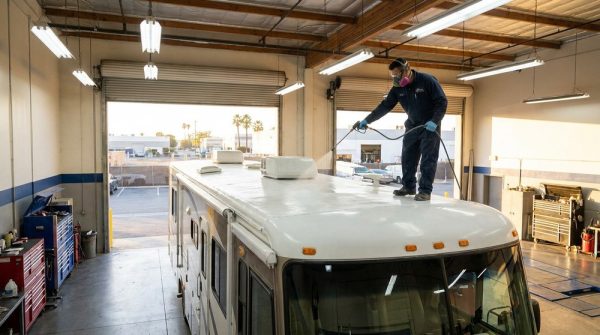
 San Diego RV Center has offered Rhino roof coating as a certified service at its El Cajon shop off Interstate 8. If you own a motorhome or travel trailer and have been researching longer-lasting alternatives to standard lap sealant, understanding Rhino roof coating for RVs is a good starting point. This guide covers what it is, how it works, and whether your rig qualifies.
What Rhino Roof Coating Is — and What It Isn’t
Rhino roof coating is a spray-applied polyurea or polyurethane membrane that bonds to your RV’s existing roof surface. It is not a caulk, a paint, or a patch. It forms a thick, uniform layer across the entire roof — seams, vent flashings, and lap joints included — in a single application pass. That continuous surface is the core difference between Rhino coating and anything applied with a brush or caulking gun.
Standard lap sealants fill specific gaps and work on a short replacement cycle. UV exposure, daily heat swings, and the constant flex of a roof moving down the highway cause them to shrink, crack, and lose adhesion within 12 to 24 months. Rhino coating moves with the roof rather than against it, which changes the durability timeline significantly. San Diego RV Center holds a Rhino coating certification, meaning the product is applied to manufacturer specifications — adhesion quality depends entirely on surface prep and technique.
How the Coating Bonds to Your RV Roof
The process starts with a complete roof inspection and written assessment. Any existing damage — soft spots, delaminated sections, cracked vent flanges — is identified and addressed before the coating goes on. Rhino coating is a protection product, not a structural fix; underlying damage must be repaired first. Once the surface passes inspection, the roof is cleaned, degreased, and masked at the edges and fixtures. The coating is spray-applied in a controlled, even pass and cures into a solid bonded membrane within hours inside San Diego RV Center’s covered bay.
Why Southern California’s Climate Makes This Worth Considering
San Diego looks like a gentle environment for RVs. For roof membranes, it delivers real stress. UV intensity at Southern California’s latitude is among the highest in the country — the RVIA has documented that EPDM membranes in high-UV regions degrade measurably faster than in cooler northern markets. Rhino coating includes UV inhibitors built into the material itself, not applied as a surface treatment that wears off with the first season.
Daily temperature swings add to the pressure. Mornings near El Cajon can sit in the low 60s while inland areas push into the 90s by early afternoon. Every cycle causes roof materials to expand and contract, working lap sealant loose at the seams. A fully bonded coating layer handles that movement without cracking — and stops a small seam failure from becoming a $10,000 interior water damage job.
Not Sure If Your Roof Qualifies for Rhino Coating?
San Diego RV Center will inspect your roof and give you a straight answer — no upsell if coating is not the right fit for your rig.
Get a Free Estimate or call us at (619) 561-3531.
What the Application Process Looks Like
When you bring your RV to San Diego RV Center, the technician walks the roof, documents its condition, and confirms the full scope of prep before anything is applied. You know the cost before the job begins. After prep and any needed repairs, the coating is applied and cured in the covered bay — most Class A motorhomes and travel trailers are done within one to two shop days. You leave with written documentation useful for insurance claims, resale, or warranty conversations with your manufacturer.
How Long Rhino Roof Coating Lasts
Applied correctly to a structurally sound roof, Rhino coating outlasts standard sealant schedules by a significant margin. Most lap sealants need reapplication every 12 to 24 months. A properly applied Rhino coating can protect an RV roof for 10 years or more under normal use and storage conditions. Actual lifespan depends on outdoor storage exposure, physical impacts, and whether the roof receives periodic professional inspections. San Diego RV Center recommends annual roof checks, and the full maintenance service lineup makes it easy to bundle that inspection with your annual appointment.
What Rhino Roof Coating Costs for an RV
Cost varies by roof size, existing condition, and prep work required. At San Diego RV Center, Rhino roof coating typically runs between $1,800 and $3,500 for a standard Class A motorhome, including the inspection and surface prep. Class C rigs and travel trailers generally fall at the lower end of that range. Compare that to full roof replacement at $4,000 to $9,000 or more. For a structurally sound but aging roof, coating is frequently the right financial call — it extends the roof’s life at a fraction of replacement cost, and a documented Rhino coating adds measurable value at resale.
Is Rhino Coating the Right Choice for Your Rig?
Rhino RV roof coating is a protection product, not a repair product. If your roof has significant delamination, structural soft spots, or water that has already worked into the ceiling or walls, those issues need to be fixed first. Coating over a compromised substrate will not adhere correctly and will not stop an active leak. For a roof that is structurally intact but showing its age — dried seams, surface oxidation, or approaching the end of a sealant cycle — Rhino coating is one of the most durable long-term options available. If you are not sure which category your rig falls into, the free inspection process at San Diego RV Center will answer the question before any commitment is made.
Frequently Asked Questions About Rhino Roof Coating for RVs
Can Rhino coating be applied over an existing EPDM rubber roof?
Yes, in most cases. EPDM is one of the more compatible surfaces for Rhino coating, provided the membrane is fully adhered and free of significant damage. The prep process includes adhesion testing before application begins. If the membrane is lifting or severely deteriorated, it may need to be repaired or removed first.
Will Rhino roof coating void my RV’s manufacturer warranty?
Most RV manufacturer warranties cover the original membrane and structure — not aftermarket coatings applied later. Policies vary by brand and model year, so verify with your manufacturer before the job starts. San Diego RV Center can walk through documentation questions with you ahead of time.
How do I maintain a Rhino-coated RV roof?
Maintenance is minimal. Keep the roof clean, inspect it twice a year for physical damage, and avoid walking on it unless the surface is rated for foot traffic. There is no annual resealing schedule — the coating handles that. Annual professional inspections are recommended to catch any surface wear before it creates a water problem.
Does Rhino roof coating work on fiberglass RV roofs?
Yes. Properly prepped fiberglass surfaces accept Rhino coating well, and the rigid structure puts less movement stress on the coating than flexible rubber membranes do. The bonded layer also adds impact resistance that bare fiberglass doesn’t provide on its own.
Ready to Get Started?
If your RV roof is aging, recently repaired, or you want to get ahead of the next leak before your next trip, Rhino roof coating at San Diego RV Center is worth a conversation.
Get a Free Estimate or call us at (619) 561-3531.