
RV Repair Questions, Answered by San Diego RV Center
We have been repairing motorhomes, travel trailers, fifth wheels, and horse trailers in San Diego County since 1990. Over 35 years that adds up to a lot of the same questions asked at the service counter — about cost, about timelines, about whether a problem is urgent or can wait until after the trip. This page collects 73 of them, grouped by service, with straight answers rather than sales copy.
Use the links below to jump to your service, or browse the whole page. If your question is not here, contact our El Cajon shop or call (619) 561-3531 and ask a technician directly. You can also browse our full list of RV services, check the communities we serve, or see why RV owners choose us.
Jump to a topic:GeneralRoof RepairRhino EcoCoatCollision & FiberglassSlide-OutsA/C & AppliancesElectrical & SolarGeneratorsMaintenance & OilCARB TestingHorse TrailersInsurance & WarrantyService Areas
General Questions & Getting Started
New to San Diego RV Center, or just trying to figure out where to start? These are the questions we field every day at the counter — hours, estimates, appointments, what we work on, and how we handle your rig once it is here. If you would rather talk it through, contact our El Cajon shop or call (619) 561-3531.
Why should I choose SD RV Center over a general auto shop or dealership?
General auto mechanics are trained on cars and trucks. RVs are a completely different animal — they combine automotive systems with residential plumbing, electrical, HVAC, and structural components that most auto shops have never worked on. Taking your RV to a general shop for a roof leak or slide-out problem is like taking your boat to a tire shop. You need someone who knows what they're looking at.
SD RV Center has been working exclusively on RVs since 1990. Our technicians have seen every make, model, and failure mode. We're also significantly faster and more affordable than dealerships, which often have 4–6 week wait times and flat-rate labor charges that don't reflect actual job complexity. We give you a fair estimate, do the work right, and stand behind it.
Where is San Diego RV Center located and what are your hours?
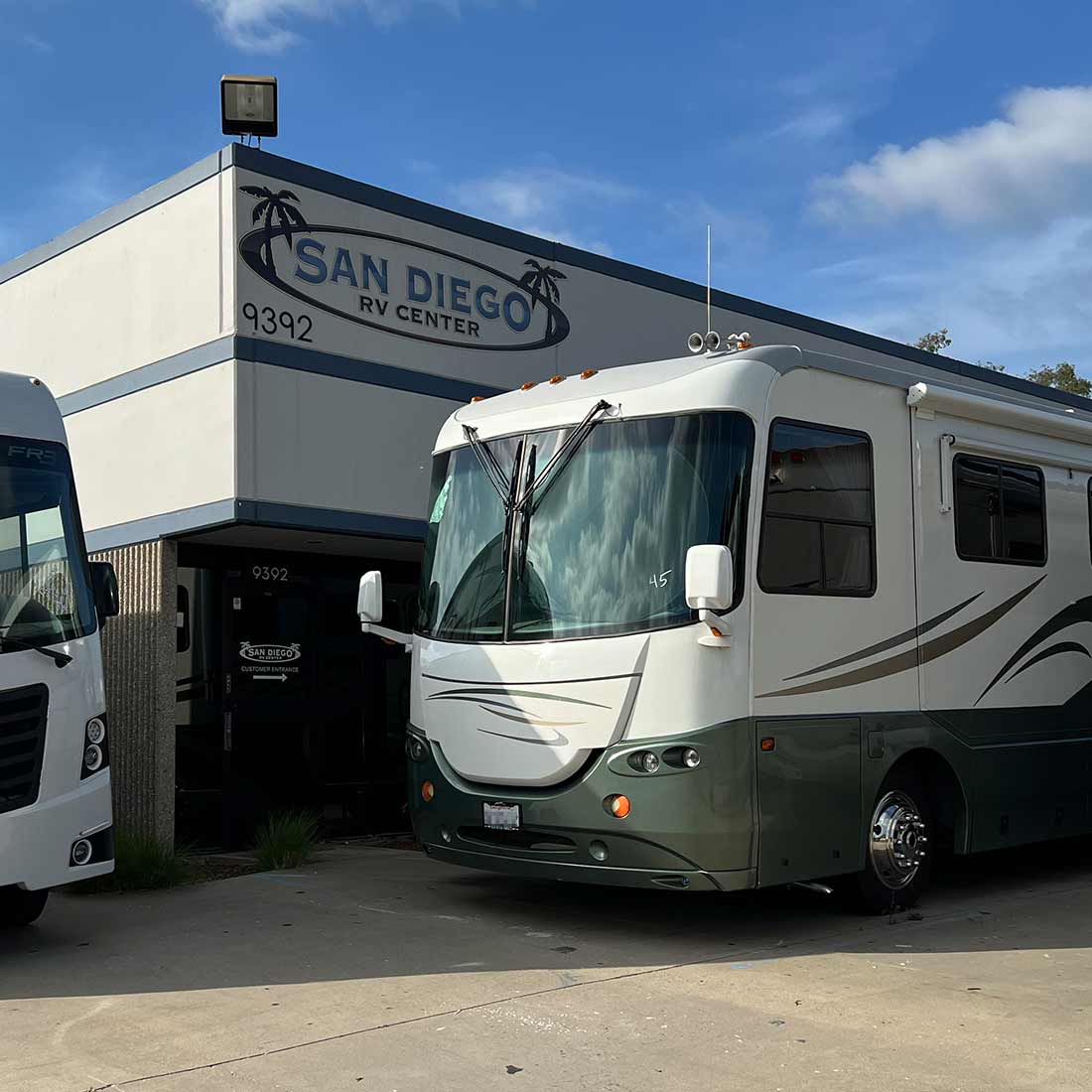
We are at 9398 Bond Ave, El Cajon, CA 92021, just off Interstate 8 in East County. That location is deliberate: it keeps us reachable from Mission Valley, La Mesa, Santee, Lakeside, Spring Valley, Lemon Grove, Alpine, and the South Bay without dragging a 38-foot coach through downtown traffic.
Our service department is open Monday through Friday, 7:30 AM to 4:30 PM. We are closed on major holidays. If you are coming from outside East County, call ahead — we will tell you the easiest freeway approach for your rig size and make sure someone is at the gate to walk you in. Full directions, a map, and our contact form are on the contact page.
Do I need an appointment, or can I just drop my RV off?
An appointment is strongly recommended, and for anything beyond a quick look it is effectively required. We are a real shop with a finite number of bays and lifts, and large motorhomes take up a lot of both. Walking in unannounced with a Class A usually means waiting or coming back.
That said, we are not rigid about it. If you have an active leak, a slide-out stuck in the extended position, or a failure that makes the RV unsafe to drive, call us and say so. We keep some flexibility in the schedule specifically for those situations. For routine work — annual maintenance, an oil change, CARB testing — book ahead and you will be in and out far faster.
Do you charge for estimates?
For most jobs, no. We will look at your RV, tell you what we see, and give you a written estimate before any work starts. That has been our policy since 1990 and we are not interested in changing it.
The exception is diagnostic work. If the problem requires real teardown time to find — tracing an intermittent electrical fault, pulling interior panels to locate the source of a water leak, or diagnosing a slide-out that fails only under load — that is billable labor, and we tell you the diagnostic charge up front before we start. What we will never do is begin work and then hand you a surprise. You approve the estimate, then we turn wrenches.
What types of RVs and trailers do you work on?
Class A, Class B, and Class C motorhomes; fifth wheels; travel trailers; toy haulers; truck campers; pop-ups; and horse and livestock trailers. Gas and diesel. All major manufacturers — Winnebago, Thor, Forest River, Jayco, Tiffin, Newmar, Coachmen, Fleetwood, Keystone, Grand Design, Airstream, and the rest.
We work on both halves of an RV, which matters more than most owners realize. A motorhome is an automotive chassis and a house bolted together, and the two need different skill sets. Our technicians handle the chassis side — engine service, brakes, suspension, generators — and the coach side, meaning roofs, electrical and plumbing, appliances, slide-outs, and body work. You do not need two shops.
How long has San Diego RV Center been in business?
Since 1990 — more than 35 years working exclusively on recreational vehicles in San Diego County. We are not an auto shop that added RVs as a sideline, and we are not a dealership service department that treats repair as an afterthought to selling units.
Longevity in this trade is not just a marketing line. RV construction changed enormously between 1990 and today: roof membranes, slide mechanisms, house electrical, and lamination methods have all been redesigned repeatedly. Having worked through every one of those transitions means we know the specific failure modes of a 2004 fifth wheel as well as a 2024 diesel pusher. You can read more on our history page and see what customers say on our testimonials page.
Do you warranty your repair work?
Yes. We stand behind our workmanship, and the specific coverage depends on the job and on the parts involved — parts carry their own manufacturer warranties, which vary quite a bit between, say, a roof membrane and an air conditioner.
We will spell out the warranty terms on your written estimate and again on your invoice, so there is no ambiguity about what is covered and for how long. If something we repaired fails within that window, bring it back and we will make it right. That is the entire point of using an established shop rather than the cheapest bidder: there is someone to go back to. Our approach to this is covered further on our why choose us page.
Do you offer emergency or same-day RV repair in San Diego?
We do our best to accommodate urgent situations. If you've just discovered a roof leak before a trip, your slide-out is stuck in a dangerous position, or you're dealing with an electrical issue that makes the RV unusable, call us directly and explain the situation. We'll tell you honestly whether we can work you in the same day or next morning based on what we have in the shop.
We're not a 24/7 mobile service, but our shop is open Monday through Friday, 7:30 am to 4:30 pm, and we keep a flexible schedule for repairs that can't wait. The best thing you can do in an emergency is call us as early in the day as possible — the earlier we know, the more likely we can get you in.
Related services: All RV Services · Why Choose Us · Our History · Contact Us
RV Roof Repair & Replacement
Roof failure is the single most expensive problem an RV owner can ignore, because water never stops at the roof — it moves into the decking, the walls, and the interior. San Diego's relentless UV is what kills most roofs here, not rain. Below are the questions we get most often about RV roof repair and full roof replacement.
How much does RV roof repair cost in San Diego?
The cost of RV roof repair in San Diego depends on the type of damage, your roof material, and the size of your rig. Minor resealing or patching typically runs $200–$600. A partial section repair — fixing a soft spot, addressing seam failure, or replacing a damaged area — generally falls between $800 and $2,500. A full roof replacement at our San Diego facility ranges from $1,500 to $5,000 or more depending on roof type (EPDM, TPO, or fiberglass) and the size of your RV.
We always provide a written estimate before any work begins. No surprises — that's a promise we've kept since 1990.
How do I know if my RV roof needs to be repaired or replaced?
There are clear warning signs your RV roof needs professional attention: water stains on the ceiling or walls, soft spots when you walk on the roof, visible cracking or crazing in the roof membrane, bubbling or delamination of interior wall panels, or seams and sealant that have pulled away from the edges. If you catch these early, a targeted repair is often all you need.
If the damage is widespread — covering more than 25–30% of the roof surface, or if the substrate (the wood decking underneath) is rotted — a full replacement is usually more cost-effective long-term. When in doubt, bring your RV in for a free roof inspection. We'll give you an honest diagnosis, not the most expensive option.
Is it better to repair my RV roof or just replace the whole thing?
The honest answer: repair when the damage is localized and the roof membrane is otherwise in good condition. Replace when the membrane is brittle or cracked across a wide area, the decking underneath is soft or rotted in multiple spots, or when a series of targeted repairs would cost more than 50–60% of a full replacement.
A full replacement also makes sense if your RV is newer and worth protecting long-term — a new roof adds years to the vehicle's useful life and protects the interior against the most costly type of damage (water intrusion). We'll lay out both options with honest pricing and let you decide. We're not going to push a replacement if a repair will do the job.
What is the difference between EPDM, TPO, and fiberglass RV roofs?
EPDM (rubber): The most common RV roof material. Flexible, affordable, and durable in most climates. Requires periodic resealing — typically every 1–3 years — to prevent UV and weather-related cracking at the seams. If you're not sure what kind of roof you have, chances are it's EPDM.
TPO (thermoplastic): A white, heat-reflective membrane that's increasingly used on newer rigs. TPO is more resistant to UV damage and is generally easier to keep clean. It's heat-welded at the seams rather than glued, which creates a very durable bond when installed correctly.
Fiberglass: Found on higher-end motorhomes. Extremely durable and resistant to impact, but can crack around seams and edges over time and is more expensive to repair or replace than rubber roofing. Each type has a different repair process, and our technicians are experienced with all three.
What causes most RV roof leaks?
Almost never the middle of the roof. In our shop, the overwhelming majority of leaks start at a penetration or a seam — the sealant around a vent, a skylight, an air conditioner gasket, an antenna base, a refrigerator vent, or the front and rear caps where the roof meets the walls.
The mechanism is simple and it is driven by sun, not storms. UV breaks down the lap sealant, the RV flexes and vibrates down the highway, the sealant cracks or shrinks away from the edge, and water finds the gap. Because it enters at a penetration and then travels along the decking, the stain that finally shows up on your ceiling is frequently nowhere near the actual entry point. That is why chasing a leak by looking at the ceiling stain wastes time. We track it from the roof down.
Can I walk on my RV roof?
Depends entirely on the construction, and getting this wrong is expensive. Many motorhomes have a fully walkable roof with proper structural support. Plenty of travel trailers and lighter fifth wheels do not — step in the wrong place and you will crack the membrane or crush the decking.
Check your owner's manual first. If it is rated walkable, distribute your weight over the rafters (they usually run side to side and you can often feel them underfoot), wear soft clean shoes, and never step within a few inches of the outer edge. If the roof is already showing soft spots, stay off it entirely — a soft spot means the decking underneath has absorbed water and lost its strength, and your weight will make the repair significantly worse. When in doubt, let us do the roof inspection.
How often should I reseal my RV roof?
For most EPDM rubber roofs, we recommend inspecting all seams, edges, and roof penetrations (vents, skylights, antennas) at least once a year — and resealing wherever you see cracking, shrinkage, or separation. In San Diego's climate, UV exposure is the primary enemy. Even if your roof looks fine, the sealant around penetrations should be replaced every 1–3 years as a preventive measure.
The most expensive RV roof repair we see is one that was ignored for two or three seasons. A $150 tube of sealant applied on time can prevent a $4,000 interior repair bill later. We offer a quick roof reseal service and can walk you through what to watch for going forward.
How long does RV roof repair or replacement take?
Here's a realistic breakdown by job type:
Resealing and minor repairs: Same day to 1 business day. Partial section repair or soft spot fix: 1–3 business days depending on how much substrate damage is underneath. Full EPDM or TPO roof replacement: 2–5 business days for most rigs. Fiberglass roof work or extensive water damage repair: Can take 5–10+ business days.
We know your RV is more than a vehicle — it's how you live and travel. We give you honest timelines upfront and call you immediately if something changes. Our shop is conveniently located off Interstate 8, making drop-off and pickup straightforward for San Diego County residents.
What is RV roof delamination and how is it repaired?
Delamination happens when water gets between the layers of your RV's wall or roof panels — typically the outer skin, the foam insulation, and the interior paneling — causing them to separate and bubble. You'll notice it as a wavy or bubbling appearance on the exterior walls, or soft, spongy sections when you press on them. It's usually caused by a slow leak that went undetected for months or years.
Repair involves removing the affected panels, drying out the substrate, replacing damaged insulation, and reinstalling or replacing the exterior skin. Early-stage delamination is far more affordable to fix than advanced cases where the structural integrity of the wall is compromised. If you see bubbling on your exterior walls, bring it in — the longer you wait, the bigger the repair bill.
Related services: RV Roof Repairs · RV Roof Replacement · Rhino EcoCoat Roof Coating · Fiberglass Repair
Rhino EcoCoat RV Roof Coating
Rhino EcoCoat is a spray-applied, seamless protective membrane that bonds to your existing roof. For a lot of San Diego RVs it is the middle path between endlessly chasing sealant and paying for a full roof replacement. Here is what owners ask before committing to it.
What is Rhino roof coating and is it a good option for my RV?
Rhino roof coating is a spray-applied protective membrane — similar in concept to Rhino truck bed liner — that bonds directly to your existing RV roof. It creates a seamless, watertight barrier that is highly resistant to UV damage, punctures, and thermal expansion. Unlike traditional sealants that need to be reapplied every few years, a properly applied Rhino coating can last well over a decade with minimal maintenance.
SD RV Center is one of the few Rhino-certified RV shops in San Diego. We recommend it for RVs with older EPDM roofs that are showing early deterioration but don't yet need a full replacement — it's a cost-effective way to extend your roof's life by 10+ years. Call us to find out if your RV is a good candidate.
How much does Rhino EcoCoat RV roof coating cost?
Price is driven by the square footage of your roof and, more importantly, by the condition it is in when it arrives. The coating itself is applied to a prepared surface — if your existing membrane needs seam work, sealant removal, or a soft-spot repair before coating, that prep is part of the job and part of the cost.
What we can tell you plainly is how the math usually lands: coating a serviceable roof is meaningfully less than a full tear-off and replacement, and because it eliminates the yearly reseal cycle it tends to come out ahead over a five- to ten-year horizon. We measure your roof, inspect the substrate, and give you a written number before anything starts. Contact us with your rig's year, make, model, and length and we will get you close over the phone.
How long does Rhino EcoCoat last and is it warrantied?
Applied correctly to a properly prepared roof, a Rhino coating is built to last well over a decade — dramatically longer than the one-to-three-year cycle you get from traditional lap sealant. It stays flexible through thermal expansion, resists UV, and resists punctures from branches and debris.
Coverage terms come from the product manufacturer and we will go over the specifics with you in writing before the job. The bigger point is the failure mode you are eliminating: a coated roof is seamless, so there are no lap joints sitting there waiting to crack open. Most of the expensive water damage we repair — delamination, rotted decking, ruined interior panels — traces back to a seam that opened up and went unnoticed.
Can Rhino EcoCoat go over my existing EPDM, TPO, or fiberglass roof?
Yes — that is precisely what it is designed for. It bonds over EPDM rubber, TPO, and fiberglass without a tear-off, which is why it is so much less disruptive than a replacement.
The one hard requirement is that the substrate underneath has to be sound. Coating is a sealing system, not a structural repair. If the decking under the membrane is soft or rotted, that damage has to be repaired before coating goes on, or you have simply sealed a problem inside where you cannot see it get worse. When your RV comes in we inspect the roof surface and probe for soft spots first, and we will tell you honestly if you are a coating candidate or if you have crossed the line into needing replacement.
Related services: Rhino EcoCoat Roof Coating · RV Roof Repairs · RV Roof Replacement
Collision, Body & Fiberglass Repair
From a clipped mirror in a campground to structural frame damage, RV collision repair is its own discipline — nothing about a laminated sidewall behaves like a steel car fender. We follow manufacturer-approved repair procedures and work directly with your insurance carrier. These are the questions that come up after an accident.
My RV was just in an accident. What should I do first?
Handle safety and the police report first, then document everything before anything gets moved or cleaned up. Photograph the damage from multiple angles and distances, including wide shots that show the whole vehicle for context. Get the other party's insurance information. Then call your insurer and open the claim.
Call us early in that process — ideally before the adjuster inspects. RV damage is routinely underestimated by adjusters who work primarily on cars, because the visible damage on a laminated sidewall is usually the smallest part of the problem. We produce detailed written damage assessments that document the full scope, including structural and substrate damage behind the skin, which is what gets a claim funded correctly the first time instead of requiring a supplement halfway through the repair.
Do you work directly with my insurance company on RV collision claims?
Yes, and we do it constantly. We accept and work with Progressive, National General, GEICO, Allstate, Foremost, State Farm, Farmers, The Hartford, Auto-Owners, AAA, American Family, Good Sam, Roamly, Explorer, RV America Insurance, and USAA, among others.
Practically, that means we communicate directly with your adjuster, supply the documentation and photos they require, negotiate supplements when hidden damage turns up during teardown, and keep you out of the middle of it. RV claims almost always involve a supplement, because you cannot know what the substrate looks like until the outer skin comes off. Handling that back-and-forth is a normal part of the job here. The full carrier list is on our insurance and warranty page.
Do I have to use the repair shop my insurance company recommends?
No. In California you have the right to choose who repairs your vehicle. An insurer can recommend a shop from their network, but they cannot require you to use it, and declining a recommendation does not void your coverage.
This matters more for an RV than for a car. Network shops are overwhelmingly automotive collision centers, and a body shop that is excellent with unibody sedans may have never repaired a laminated fiberglass sidewall, a roof-to-wall joint, or a slide-out that was knocked out of alignment in the impact. Choosing a shop that works exclusively on RVs is not a preference, it is a quality issue. We will work with your carrier regardless of whether we are in their network.
How much does RV fiberglass repair cost?
It varies widely, because "fiberglass repair" covers everything from a surface gelcoat scuff to a delaminated sidewall that needs sectional panel replacement. A small crack or a stress spider around a mounting point is a modest repair. A cracked front cap, a punctured sidewall, or a large delaminated area involves structural work, resin and laminate build-up, fairing, and refinishing, and lands significantly higher.
The variable that moves the number most is whether water got in. Fiberglass panels on an RV are usually a laminate sandwich — outer skin, foam or lauan core, inner panel. Once water reaches the core, you are no longer repairing fiberglass, you are rebuilding a wall. That is why we push people to address small cracks and leaks early. We inspect and quote in writing before starting.
Can you repair RV sidewall damage, or does the whole panel have to be replaced?
Often it can be repaired. Sectional repair — cutting out the damaged area, rebuilding the substrate, laminating in new material, and blending the finish — is standard practice and far less expensive than a full panel swap.
Full replacement becomes the right call when the damage crosses structural framing, when delamination has spread across a large portion of the panel, or when the panel has multiple separate impact points. There is also a practical limit: at some point the labor to repair and blend exceeds the cost of the panel. We assess the damage, tell you which side of that line you are on, and show you why. What we will not do is quote a full replacement on a repairable panel because the invoice is bigger.
Can you match the paint and decals on my motorhome?
Yes. We color-match and refinish, and we handle decal and graphics replacement as part of collision and body work. Modern motorhome finishes involve multi-stage paint, clearcoat, and large-format vinyl graphics, and a repair that is structurally perfect still looks wrong if the blend is off.
Two honest caveats. First, older rigs whose finish has spent a decade in California sun have faded, so a technically correct factory-code match can look brighter than the surrounding panel — the fix is blending into adjacent panels rather than stopping at a hard edge, and we plan for that. Second, some discontinued OEM decal sets are no longer produced; when that happens we source the closest available reproduction or fabricate, and we will tell you before the work starts rather than after.
Related services: RV Collision Repairs · Fiberglass Repair · Insurance & Warranty Accepted · Roof Repairs
RV Slide-Out Repair
A slide-out that will not move turns a working RV into a parked one, and a slide that will not retract turns it into an undriveable one. We treat slide-out repair as a priority job for exactly that reason. Here is what owners ask most.
My RV slide-out isn't working. What could be wrong?
Slide-out problems are one of the most common issues we see in the shop. The most frequent causes are: a dead or weak motor, stripped gears in the slide mechanism, misaligned rails that cause the slide to bind, a blown fuse or wiring fault in the slide's electrical circuit, or hydraulic fluid issues on hydraulic-powered slides. In some cases, it's as simple as a bad connection or a tripped breaker.
Because a stuck slide can make your RV unusable — especially if it won't retract for travel — we prioritize these repairs. Bring your rig in or call us and describe what you're hearing and seeing. We can often diagnose the issue over the phone and have parts staged before you arrive. Slide-out repairs typically run $200–$1,500 depending on what's failed.
How much does RV slide-out repair cost?
The range is wide because the causes are wide. A blown fuse, a bad ground, or a failed switch is an inexpensive fix. A worn or stripped gear, a failed motor, or a bad hydraulic pump is a mid-range parts-and-labor job. A slide that has been running out of alignment long enough to damage the rails, the room frame, or the floor is the expensive end, because now you are correcting structural damage as well as the mechanism.
The pattern we see over and over: a slide that is binding, groaning, or moving unevenly gets used anyway for another season, and a $400 repair turns into a several-thousand-dollar one. If your slide sounds different than it used to, that is the moment to bring it in. We diagnose, quote in writing, and you approve before we proceed.
How do I manually retract a stuck RV slide-out?
Almost every slide-out system has a manual override, and knowing where yours is before you need it is worth ten minutes today. On electric rack-and-pinion systems it is usually a crank or drive-nut accessible from underneath the coach or through a nearby access panel. On hydraulic systems there is typically a bypass or release valve at the pump, often in a front or side compartment.
Check your owner's manual for the specific procedure for your mechanism — forcing the wrong component can wreck the gearbox. Retract only far enough to travel safely, then get it looked at. A manual retract gets you home; it does not fix the underlying fault, and continuing to operate a failing slide is how a mechanism problem becomes a structural one. Call us at (619) 561-3531 if you are stuck and unsure.
Why is my slide-out leaking when it rains?
Nine times out of ten it is the seals. A slide-out relies on wiper and bulb seals to bridge the gap between the room and the sidewall, and those seals dry out, compress permanently, crack, or tear. San Diego UV accelerates all of it. Once a seal stops making full contact, water runs down the inside of the room and into the floor.
The other common cause is alignment. A slide that is not sitting square cannot compress its seals evenly, so it leaks along one edge even with seals that look fine. That is why we inspect operation and alignment, not just the rubber. Left alone, a slide leak destroys the slide floor and the main floor underneath it — one of the more costly repairs we do, and one of the most preventable.
How often should slide-out seals be lubricated or replaced?
Treat the seals with a UV-protectant rubber conditioner two to three times a year in this climate, and inspect them every time you wash the rig. Conditioning keeps them pliable; dry rubber is what tears. Keep the seal surfaces clean, because grit trapped against a seal acts like sandpaper every time the room moves.
Replacement intervals vary with exposure and use, but seals that have gone hard, flattened, cracked, or that no longer spring back when you press them are done, regardless of age. We check seal condition and slide alignment as part of annual RV maintenance, which is by far the cheapest way to catch this — a set of seals costs a fraction of a slide floor.
Related services: RV Slide-Out Repair · RV Electrical Repair · General Repair Services · Annual Maintenance
Air Conditioning & RV Appliances
A San Diego summer will find every weakness in an RV cooling system, and the appliances that make an RV livable — fridge, water heater, furnace — fail in predictable ways. We service and replace all of it. See our RV A/C replacement page for the cooling side.
My RV air conditioner stopped working. Can you fix it?
Yes — RV AC repair is one of our most-requested services, especially heading into San Diego summers. Common causes include a frozen evaporator coil (usually from a dirty air filter or low refrigerant), a failed capacitor or compressor, a wiring fault, or a thermostat that's gone bad. In some cases the unit is running but not cooling efficiently because the gasket between the AC unit and the roof has dried out and is letting warm air in.
We work on all major RV AC brands including Dometic, Coleman-Mach, and Advent Air. If your AC is making noise, not blowing cold, or not turning on at all, call us and we'll run a diagnostic. We'll tell you honestly whether a repair makes sense or whether it's time to replace the unit.
Should I repair or replace my RV air conditioner?
Repair when the failed part is discrete and the unit is otherwise healthy — a capacitor, a fan motor, a thermostat, a control board. Those are common failures with sensible parts costs.
Replace when the compressor has failed, when the unit is leaking refrigerant, or when it is old enough that you are about to start replacing components one at a time. RV rooftop air conditioners are largely sealed systems; a dead compressor is usually the end of the line economically. There is also a real efficiency argument — a current-generation unit cools noticeably better on the same power draw, which matters if you dry camp or run on a solar and battery setup. We will tell you which side of the line your unit is on instead of defaulting to the bigger invoice.
How much does RV air conditioner replacement cost?
It comes down to the unit you choose and what the install involves. A straight swap of a standard non-ducted rooftop unit for a comparable model is the low end. Ducted systems, higher-BTU units, heat pump models, and low-profile or quiet-series units cost more for the equipment itself.
Install variables matter too: the condition of the roof opening and gasket, whether the existing wiring is adequate for the new unit's draw, and whether the thermostat and control system need to be updated to match. We always replace the roof gasket during an A/C swap — reusing a compressed gasket is a leak waiting to happen, and a leak at the A/C opening is one of the most common sources of roof and ceiling water damage we repair. Written estimate before we start.
My RV refrigerator isn't cooling. Can you fix it?
Yes, and the first question is which type you have. An absorption fridge (Dometic or Norcold, running on propane and 120V) fails differently than a residential-style compressor fridge. On absorption units the usual suspects are a failed cooling unit, a blocked or dirty burner, a bad igniter or thermistor, poor ventilation behind the unit, or a control board fault.
One thing worth knowing: absorption refrigerators need to be reasonably level to circulate their coolant. Running one badly off-level for extended periods can permanently damage the cooling unit. If your fridge cools poorly only when parked on a slope, that is a clue, not a coincidence. We diagnose the actual failure rather than guessing, and we will tell you honestly when a cooling unit replacement is not worth it on an older rig.
My RV water heater or furnace won't light. What's wrong?
Both are propane appliances and both tend to fail for the same handful of reasons: no propane getting to the appliance, a dirty or obstructed burner, a failed igniter or electrode, a bad gas valve, a tripped high-limit or thermal cutoff, or low 12V battery voltage. That last one catches a lot of people — furnaces in particular need healthy 12V to run the blower, and a weak battery produces a unit that clicks and quits.
Spiders are also a genuine and frequently overlooked cause in Southern California; they nest in burner tubes and choke the flame. If your appliance worked fine before storage and will not light after, that is high on our list. We service propane systems and appliances as part of general RV repair, and we leak-test the system whenever we work on it.
Related services: RV A/C Replacement · RV Electrical Repair · General Repair Services · Solar Installation
Not Finding Your Answer?
Every RV is different, and some problems need eyes on them. Call (619) 561-3531 and describe what is happening — you will talk to someone who works on RVs for a living, not a call center. Our El Cajon shop is right off Interstate 8.
Electrical, Batteries & Solar
An RV carries two separate electrical systems — 12-volt DC house power and 120-volt AC shore power — plus a converter or inverter bridging them. Most "weird" RV problems trace back to one of the two. We handle electrical diagnosis and repair and full solar installations.
Nothing in my RV has 12-volt power. Where do I start?
Work from the source outward. Check the battery disconnect switch first — it gets bumped constantly and it is the single most common cause of a totally dead coach. Then check battery voltage at the terminals; a healthy 12V battery reads roughly 12.6 volts at rest, and anything under about 12.0 is deeply discharged. Then inspect the main fuse or breaker at the battery and the battery terminals themselves for corrosion or a loose ground.
If all of that checks out, the fault is usually the converter (not charging), a chassis ground, or a failed main disconnect solenoid. Corroded grounds are the sneakiest of the group because they produce intermittent, seemingly unrelated symptoms all over the coach. If you have gotten this far without finding it, bring it to us — chasing intermittent 12V faults is exactly what a meter and experience are for.
Do you troubleshoot RV wiring and shore power problems?
Yes — it is one of the most common things we do. That includes shore power that trips the pedestal breaker, outlets that are dead on one circuit, reverse polarity or open ground faults, failed transfer switches, converter and distribution panel problems, and the general category of "it works sometimes."
Two warnings worth stating plainly. First, a pedestal breaker that trips repeatedly is telling you something is wrong in the coach, not that the campground has a bad pedestal — do not keep resetting it. Second, RV electrical faults are a genuine fire risk, particularly at the shore power inlet, where a loose or heat-damaged connection can smolder inside the wall. If you smell hot plastic or see discoloration around the inlet, stop using it and call us.
My converter isn't charging the batteries. What could it be?
Start simple: confirm the converter is actually getting 120V power, and check its own fuse or breaker. Converters are frequently fed from a breaker in the AC panel that has tripped without anyone noticing. Also check the DC output fuses at the distribution panel — many converters have a pair of automotive fuses on the output side that fail quietly.
If it is powered and fused and still not charging, the converter itself may have failed, or the batteries may be too far gone to accept a charge. That second case matters: a lead-acid battery that has been deeply discharged and left sitting can become sulfated to the point where a good converter cannot recover it, and people replace a perfectly functional converter chasing a dead battery. We test both before recommending either.
Should I switch from lead-acid to lithium RV batteries?
If you dry camp, boondock, or run an inverter regularly, usually yes. Lithium (LiFePO4) gives you far more usable capacity for the same nameplate amp-hours, because you can safely draw a lithium bank down much further than a lead-acid bank without damaging it. It also weighs less, charges faster, and lasts through many more cycles.
The honest counterpoint: the upfront cost is substantially higher, and it is rarely a drop-in swap despite the marketing. Your converter or charger may have the wrong charge profile, your alternator charging path may need a DC-to-DC charger to protect it, and some older systems need monitoring added to be useful. If you camp on shore power nearly every trip, lead-acid is still perfectly rational. We will size the system to how you actually travel — see our solar and power page.
How much does RV solar installation cost, and how many panels do I need?
It depends entirely on what you want to run. A small maintenance array that keeps batteries topped up in storage is a modest job. A full off-grid system — multiple panels, a lithium bank, an inverter, a charge controller, and monitoring — is a serious investment and a multi-day install.
The sizing question is answered by your daily consumption, not by guessing at panel counts. Lights, fans, water pump, and device charging need far less than a residential refrigerator running around the clock. We calculate your actual daily amp-hour usage first, then size the array and the battery bank to it, because an oversized array feeding an undersized battery bank is wasted money. Details on our RV solar installation page.
Can I run my air conditioner on solar?
You can, but it takes a substantial system and we would rather tell you that up front than sell you a disappointment. A rooftop air conditioner is by far the largest load in an RV, and running one for any meaningful stretch requires a large battery bank and a high-output inverter — the panels alone are not the constraint, the storage is.
There are ways to make it more achievable: a soft-start module on the A/C dramatically reduces the startup surge the inverter has to handle, and a modern high-efficiency or heat pump air conditioner draws less to begin with. For many owners the practical answer is a system sized for everything else, with the generator handling A/C on the hottest days. We will lay out what each option actually costs.
Can you install an inverter in my RV?
Yes. An inverter converts your 12V battery power into 120V household power so you can run outlets, a television, a microwave, or a residential refrigerator without shore power or a running generator.
The install is where the quality difference shows. Inverters draw very high current on the DC side, which means correctly sized cable, proper fusing close to the battery, and a solid ground — undersized wiring on an inverter install is a fire hazard, full stop. We also sort out what the inverter feeds: a dedicated subpanel or transfer switch so the right circuits are powered and the converter is not fed by the inverter, which creates a loop that drains your batteries for nothing. We size and wire it properly, then label it so the next person knows what is where.
Related services: RV Electrical Repair · Solar Installation · Generator Repair · A/C Replacement
RV Generator Repair & Service
The onboard generator is the most neglected system in most RVs, and neglect is exactly what kills it. We service and repair all the major brands — see our RV generator repair page.
My RV generator won't start. What are the most common causes?
In our shop the order is roughly: stale fuel, a dead or weak start battery, a clogged fuel filter, a fouled or failed spark plug on gas units, a dirty air filter, or a fuel pump that has given up. Many generators also refuse to start when the fuel tank drops below roughly a quarter — the pickup tube is deliberately short so you cannot strand yourself, and owners regularly mistake that for a failure.
Stale fuel is the single biggest cause and it is entirely self-inflicted. Gasoline degrades in months, and a generator that sat all winter with old fuel in the carburetor will usually need that carburetor cleaned or rebuilt. The prevention is free: run the generator under load for about half an hour every month. Bring it to us if it cranks but will not fire — we diagnose generators properly rather than parts-swapping.
How often should I service my RV generator?
Follow hours, not the calendar. Most manufacturers call for an oil and filter change somewhere in the 100-to-150-hour range, with air filter and spark plug service on a similar or slightly longer interval. Check your generator's own manual, since the interval differs between gas and diesel units and between brands.
The rule that saves the most generators, though, is monthly exercise: run it for about 30 minutes under real load — turn on the air conditioner, not just the lights. Running it unloaded is nearly worthless and on diesel units it causes wet stacking, where unburned fuel accumulates in the exhaust. Exercise circulates oil, keeps seals wet, and burns off moisture. We include generator service with annual RV maintenance and can do the oil service alongside your chassis oil change.
Do you repair Onan, Cummins, Generac, and other RV generator brands?
Yes. Onan and Cummins Onan units are the most common in motorhomes and we see them constantly, along with Generac, Honda, Champion, and the various OEM-branded units installed by RV manufacturers. Gas, diesel, and LP-fueled.
Service covers routine maintenance, fuel system work including carburetor cleaning and rebuild, ignition and starting faults, control board and wiring diagnosis, exhaust and mounting repairs, and output problems where the unit runs but will not produce clean power. That last category overlaps heavily with the coach's electrical system — a failed transfer switch will look exactly like a failed generator to the owner, and diagnosing which one you actually have is half the job.
Is it worth repairing an old RV generator or should I replace it?
Repair is usually the right call. Generators are simple, durable machines, and most no-start complaints come down to fuel system service or a battery — both inexpensive relative to a new unit. High hours alone are not a death sentence if the unit was maintained.
Replacement makes sense when the engine itself is worn out (low compression, heavy oil consumption, hard starting even after full service), when the unit is undersized for what you now run — a common problem after adding a second air conditioner — or when parts availability has dried up on an old model. We will tell you honestly which situation you are in, including the case where the answer is "replace the battery and stop worrying about it."
Related services: Generator Repair · RV Electrical Repair · Oil Changes · Annual Maintenance
Routine Maintenance & Oil Changes
Nearly every expensive repair in this FAQ started as a cheap maintenance item somebody skipped. Annual RV maintenance and on-schedule oil changes are the highest-return money you will spend on your rig.
What does routine RV maintenance include and how often should I bring my RV in?
We recommend a full service check at least once a year — ideally before peak season in spring. A standard annual inspection covers: roof condition and sealant, slide-out operation and seal condition, electrical system and battery health, propane system and appliance operation (water heater, refrigerator, furnace), plumbing and water pump, tire pressure and condition, and brake/chassis inspection.
Think of it the same way you think about maintaining your home. The systems in your RV are constantly exposed to road vibration, UV, moisture, and temperature swings. Catching a small problem during a scheduled inspection costs a fraction of repairing it after it fails on the road. We offer a comprehensive pre-trip inspection service — call us to schedule before your next adventure.
How often does a motorhome need an oil change?
Go by whichever comes first: the chassis manufacturer's mileage interval, or once a year. That annual part is what trips up RV owners — a motorhome that covers 2,500 miles a year still needs its oil changed annually, because oil degrades with time, heat cycles, and moisture, not just with miles.
Intervals differ meaningfully between a gas chassis (Ford or Chevy) and a diesel pusher (Freightliner, Spartan, or similar), and diesel units also have fuel filter and, on newer emissions systems, additional service items on their own schedules. Sitting is genuinely harder on an engine than driving, because condensation accumulates in oil that never gets fully up to temperature. We handle motorhome oil changes for both gas and diesel chassis.
How much does an RV oil change cost?
More than a car, and the reason is capacity. A gas motorhome chassis holds meaningfully more oil than a passenger vehicle, and a diesel pusher can take several times that — plus a larger, more expensive filter. Diesel service typically includes fuel filters as well.
The other factor is access. Some chassis are straightforward; others require ramps, specific lift positioning, or working around a generator and exhaust routing. We quote based on your specific chassis, and we will tell you the number before you commit. Because you are already here, it is the natural time to bundle a generator oil service or a full annual inspection — one trip instead of three.
Can you service the chassis and the coach in the same visit?
Yes, and that is one of the main reasons to use a full-service RV shop rather than splitting the work between a truck shop and an RV shop. We can change the engine oil, service the generator, inspect and reseal the roof, check slide-out operation and seals, test the house electrical and battery system, verify propane appliances, and check tires and brakes — all on one visit.
It saves more than time. When one shop sees the whole vehicle, problems get connected: a weak house battery that explains a furnace that will not light, or a roof seam that explains a soft spot in the wall. Split the work between shops and each one sees a symptom in isolation. Tell us everything you have noticed when you book — even things that seem unrelated.
How do I prepare my RV for storage?
In San Diego you are mostly defending against sun, pests, and stale fuel rather than freezing. Fill or stabilize the fuel tank, run the generator under load monthly, disconnect or maintain the batteries on a proper maintainer (a fully discharged lead-acid battery left sitting is often unrecoverable), and cover or shade the tires, which crack from UV long before they wear out.
Then close the openings. Seal or screen anything a rodent can enter — they chew wiring harnesses, and that repair is far more expensive than the prevention. Empty and clean the tanks, leave the fridge propped open and dry, and get the roof inspected before it sits, because a small seam gap that leaks for six unattended months causes catastrophically more damage than one you catch on a trip. A pre-storage inspection is cheap insurance.
What should I have checked before a long RV trip?
Tires first, always. Check pressure cold against the load rating and check the date codes — RV tires age out before they wear out, and a blowout at highway speed can destroy a wheel well, a sidewall, and your trip. Then brakes, including trailer brakes and the breakaway system if you tow.
After that: engine and generator service current, house and chassis batteries load-tested, roof and sealant inspected, slide-out operation and seals checked, propane leak-tested, and appliances confirmed working — not assumed working because they worked last year. We run exactly this as a pre-trip inspection. Book it two to three weeks before departure so there is time to fix whatever turns up, rather than the day before you leave.
Related services: Annual RV Maintenance · Oil Changes · General Repair Services · Roof Repairs
CARB Testing & California Emissions Compliance
If you own a diesel motorhome over 14,000 pounds GVWR in California, Clean Truck Check applies to you, and failing to comply puts a hold on your DMV registration. Our credentialed technicians run the inspection and submit results directly to CARB — details on our RV CARB testing page.
What is CARB testing and does my RV need it?
CARB's Clean Truck Check is California's emissions compliance program for heavy-duty vehicles. As of January 2025, heavy-duty diesel vehicles — including motorhomes and RVs with a Gross Vehicle Weight Rating over 14,000 pounds — must pass periodic emissions testing, with results submitted to the CARB database.
The practical test for most owners is simple: is your motorhome diesel, and is its GVWR over 14,000 pounds? Check the manufacturer's plate, usually inside the driver's door or in a forward compartment. If both are true, this applies to you. For most newer diesel RVs it is an OBD-based inspection rather than a tailpipe test. We are credentialed to perform it and we submit your results to CARB for you.
What happens if I skip CARB testing?
Your vehicle gets flagged with a DMV registration hold. You will not be able to renew your registration until you pass the inspection and your results are in the CARB database — which means an RV you cannot legally drive, frequently discovered at the worst possible moment, right before a trip.
Non-compliance can also carry penalties. The fix is not complicated, it just has to actually happen: get tested on schedule and make sure the results are submitted, not merely performed. We handle both halves. If you are already sitting on a hold, come in and we will get you tested and reported so you can clear it. Call (619) 561-3531 or book online.
Do gas motorhomes need CARB Clean Truck Check testing?
Clean Truck Check is aimed at heavy-duty diesel vehicles, so a gas motorhome is generally outside the program. Weight and fuel type are what determine applicability, and a diesel RV under the 14,000-pound GVWR threshold is treated differently than one above it.
Because regulations get amended and edge cases exist, do not rely on a general answer for a compliance question that gates your registration. Bring us your rig's year, make, model, fuel type, and GVWR and we will tell you exactly where you stand and what your schedule looks like. That call costs you nothing and is a great deal cheaper than discovering a registration hold in July. More detail on our CARB testing page.
How often does Clean Truck Check testing have to be done?
Testing is periodic and tied to your registration cycle rather than to a fixed date that is the same for everyone. When you come in we look up your vehicle's specific compliance status and tell you when your next test is due, so you are not guessing.
The practical advice: schedule it comfortably ahead of your registration renewal, not the week of. If the inspection surfaces a fault code or an emissions problem, you need time to repair it and retest — and a diesel emissions repair is not always a same-day job. Pairing your CARB test with your annual service or oil change is the easiest way to keep it from sneaking up on you.
Related services: RV CARB Testing · Oil Changes · Annual Maintenance · General Repair Services
Horse Trailers & Toy Haulers
Living-quarters horse trailers and toy haulers combine everything that can go wrong in an RV with everything that can go wrong in a working trailer. We repair both — see our horse trailer repair page.
Do you repair horse trailers and livestock trailers?
Yes. We service horse trailers, livestock trailers, and living-quarters combinations — bumper pull and gooseneck, aluminum and steel. That covers structural and body repair, flooring, dividers and partitions, doors and latches, ramps, roof and vent sealing, lighting and wiring, and the full living-quarters side when there is one.
A living-quarters trailer is genuinely two vehicles in one: an RV interior with plumbing, propane, 12V and shore power, plus a hard-working trailer that hauls animals over rough ground. Most shops are set up for one or the other. We handle both under the same roof, which is why horse trailer owners across San Diego County end up here instead of splitting the job between a welder and an RV shop.
Can you repair or replace horse trailer flooring?
Yes, and it is one of the more important repairs we do because it is a safety issue rather than a cosmetic one. Trailer floors take a brutal combination of weight, impact, moisture, and urine, which is highly corrosive to both aluminum and steel.
We replace rubber mats, repair or replace wood flooring, and address the frame and crossmembers underneath when corrosion has reached them — which it often has, hidden under mats that look fine from above. If you have not had the floor pulled and inspected in several years, do it. A floor that fails with a horse standing on it is a catastrophe, and it almost always gives warning signs first: soft spots, flex underfoot, visible corrosion at the seams, or rusty streaking on the underside.
Do you service toy hauler ramp doors and garage areas?
Yes. Ramp doors are a common failure point — the cables and pulleys stretch and fray, the hinges and seals wear, the springs weaken, and the door stops sealing properly, which lets water into the garage and eventually into the floor.
We repair and adjust ramp door hardware, replace cables and seals, and address the garage area itself: tie-down anchors that have pulled loose from the floor, damaged wall panels, fuel station plumbing, and the electrical in that space. We also see a lot of water damage in toy hauler garages specifically, because owners hose them out and the water finds every gap in the ramp seal. Worth having the seal checked yearly along with the rest of your annual maintenance.
Can you repair trailer axles, brakes, and suspension?
Yes. Brakes, bearings, axles, springs, shackles, equalizers, and suspension components on trailers and fifth wheels are all standard work here. Bearing service is the one people skip and should not — a bearing that fails at highway speed can seize a wheel, destroy a spindle, and put a trailer into the guardrail.
We also test and repair electric trailer brake systems, including the magnets, the wiring, and the breakaway switch, which is required and which fails silently on a surprising number of trailers we inspect. If you tow, have the brakes and bearings checked on a regular interval rather than when something starts making noise. A loaded horse trailer or toy hauler is a heavy, high-consequence vehicle and it deserves the same seriousness as the tow vehicle.
Related services: Horse Trailer Repair · Fiberglass Repair · Collision Repairs · General Repair Services
Insurance, Extended Warranties & Estimates
We work directly with most major RV insurance carriers and extended warranty administrators so you are not stuck playing middleman during a repair. The full accepted list lives on our insurance and warranty page.
Does RV insurance cover roof repair or replacement in California?
It depends on your policy and the cause of damage. Roof damage caused by a sudden event — a falling tree branch, hail, or a collision — is typically covered under your comprehensive or collision coverage. Damage that results from long-term wear, deferred maintenance, or gradual water intrusion is generally not covered.
We work with RV insurance claims regularly and can help you navigate the process. We provide detailed written damage assessments that your adjuster needs to process the claim. If you've just experienced a weather event or road damage, call us first — we'll document everything correctly so your claim goes smoothly.
Which RV insurance companies do you work with?
We accept and work directly with Progressive, National General, GEICO, Allstate, Foremost, State Farm, Farmers, The Hartford, Auto-Owners Insurance, AAA, American Family Insurance, Good Sam, Roamly, Explorer, RV America Insurance, and USAA, among others.
If your carrier is not on that list, it is very rarely a problem — we work with most insurers, and being outside a carrier's preferred network does not prevent us from repairing your RV or from being paid on the claim. Call us with your carrier and claim number and we will tell you exactly how it will work. The complete current list of accepted insurance and warranty companies is on our insurance and warranty page.
Will you help me file and manage my RV insurance claim?
Yes, and this is a real part of the service rather than a courtesy line. We communicate directly with your adjuster, provide the photos and written damage documentation they require, and negotiate supplements when additional damage is discovered during teardown — which on an RV is the norm, not the exception.
The reason it matters: adjusters largely come from an automotive background, and RV damage does not read the way car damage does. A modest-looking scrape on a laminated sidewall can hide substrate damage across several feet of wall. If that is not documented properly at the outset, the claim gets funded for the visible damage and you find out later. We document the full scope up front. See our collision repair page for how the process runs.
Do you accept extended RV warranties and service contracts?
Yes. We work with a wide range of extended warranty and service contract administrators, including Good Sam, XtraRide, Easy Care, Coach Net, Cornerstone United, USWC and USWC Eagle, AGWS, Viking, RV Complete, Portfolio Protection, Route 66, Eagle Vision, GAS Administrator Services, Phoenix American, and America's RV Warranty.
One practical note that saves people money: most contracts require authorization before work begins, and some require the administrator to approve the diagnosis first. Do not authorize repairs and then try to get reimbursed — that is how claims get denied. Bring your contract information when you drop off and we will open the claim with the administrator on your behalf. The full accepted list is on our insurance and warranty page.
How does your estimate and approval process work?
We inspect the RV, diagnose the actual fault, and put a written estimate in your hands covering parts, labor, and expected timeline. Nothing gets done until you approve it. If we discover additional damage after teardown — common on roof and collision work, where the problem is under the surface — we stop, document it, call you, and get approval before continuing.
You will not get a call from us that starts with "so we went ahead and." That discipline is the reason a lot of our customers have been coming here for decades, and it is a large part of what people mention in our customer reviews. If you want a ballpark before you drive over, call (619) 561-3531 with your rig's year, make, model, and a description of the problem.
Will using an independent RV shop void my factory warranty?
No. Under the federal Magnuson-Moss Warranty Act, a manufacturer cannot void your warranty simply because you had maintenance or repairs performed somewhere other than a dealership, or because you used aftermarket parts. To deny a warranty claim, they have to show that the outside work or part actually caused the failure.
Keep your records — itemized invoices showing what was done, when, and with which parts. That documentation is what protects you, and we provide it on every job. Warranty repairs that the manufacturer itself is covering do generally have to go through an authorized dealer, so if your rig is new and the failure is a covered defect, start there. For everything else — maintenance, oil changes, wear items, and out-of-warranty repairs — you are free to use whoever you trust.
Related services: Insurance & Warranty Accepted · Collision Repairs · Roof Repairs · Contact Us
Service Areas & Finding Our Shop
We are located off Interstate 8 in El Cajon and serve RV owners throughout San Diego County. A full breakdown of the communities we cover is on our service areas page.
What areas of San Diego do you serve?
We're conveniently located off Interstate 8 and serve all of San Diego County. Customers regularly bring their RVs to us from El Cajon, La Mesa, Santee, Alpine, Lemon Grove, Chula Vista, Mission Valley, East San Diego, and throughout the greater metro area. Our location is easy to access from both the East County freeways and the I-8 corridor.
If you're not sure whether the drive is worth it, call us first. In most cases, customers from East County and South Bay tell us the trip to our shop is faster than the wait time they'd experience at a dealership service center. We work hard to get your rig in and out as quickly as possible.
Where exactly are you located and how do I get there with a big rig?
9398 Bond Ave, El Cajon, CA 92021, just off Interstate 8. We chose an East County location precisely because it is approachable in a large vehicle — you are coming off a freeway onto surface streets built for commercial traffic, not threading a 40-foot coach through a dense urban grid.
Coming from central San Diego or Mission Valley, take I-8 east. From North County, I-15 south to I-8 east. From the South Bay, I-805 or I-5 north to I-8 east. If you are towing or driving something long and want the cleanest approach with the fewest tight turns, call us at (619) 561-3531 before you leave and we will walk you in. Directions and a map are on the contact page.
Do you have room to park a large Class A motorhome or fifth wheel?
Yes. We are set up for full-size RVs — that is the entire business. Class A diesel pushers, long fifth wheels, and living-quarters horse trailers all fit, and our yard and bays are laid out with the turning radius of a big rig in mind.
This sounds trivial until you have tried to get a 40-foot coach into a general automotive shop designed around sedans and pickups. It is one of the underrated reasons to bring an RV to an RV facility: nobody is asking you to back a 26,000-pound vehicle into a space it does not fit, and nothing gets damaged maneuvering. If your rig is unusually long or you are towing a vehicle behind it, mention it when you book so we can stage space for you.
Can I stay in my RV while it is being serviced?
Generally no, and for good reasons. An active service bay is a working environment with lifts, power tools, and vehicles moving, and for most jobs the RV's power, water, or propane needs to be shut down while we work. Roof, electrical, and body work in particular make the interior uninhabitable during the repair.
If your RV is your full-time residence, tell us when you book — that changes how we schedule the work, and we will do our best to sequence the job so the shortest possible time is spent with the rig out of service. Being upfront about your situation gets you a better outcome than hoping it works out. Call or message us and we will plan around it.
Do you offer mobile RV repair?
We are a full-service shop rather than a mobile operation. The work we do — roof replacement, collision and fiberglass repair, slide-out mechanism work, chassis service, CARB testing — requires lifts, tools, controlled conditions, and paint and laminate work that simply cannot be done properly in a campground or driveway.
That is a deliberate choice, not a limitation. A mobile tech can reseal a vent or swap a fuse. Anything structural, anything involving refinishing, and anything requiring a vehicle lift needs a real facility. If you have a situation you are not sure we can handle, call us at (619) 561-3531 and describe it — if it genuinely needs a mobile tech we will say so rather than have you tow a rig here for nothing. Local resources are listed on our resources page.
Related services: Service Areas · Contact & Directions · Local RV Resources · Testimonials
Still Have Questions About Your RV?
We have been answering these questions in San Diego County since 1990. Bring us the one that is not on this page. Call (619) 561-3531 or explore our full range of RV services.
San Diego RV Center — 9398 Bond Ave, El Cajon, CA 92021. Serving San Diego, El Cajon, La Mesa, Santee, Lakeside, Spring Valley, Lemon Grove and all of San Diego County. Read our customer reviews.