
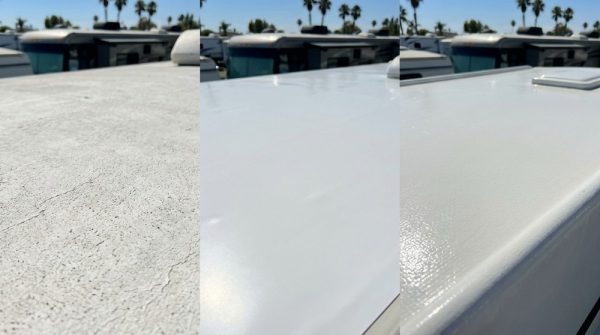
San Diego RV Center has repaired every type of RV roof at its El Cajon shop since 1990 — EPDM rubber, TPO, and fiberglass — and each one behaves differently when it ages, fails, and gets repaired. This EPDM vs TPO RV roof guide helps motorhome and travel trailer owners identify their roof material, understand how each type holds up, and know what repairs typically cost before picking up the phone.
How to Identify Your RV Roof Material
A quick visual and tactile check tells you what you’re working with. Here’s what each material looks and feels like:
- EPDM rubber: Soft, slightly textured membrane. White or light gray, often with a chalky or oxidized appearance on older units. Common on Class A and Class C motorhomes and travel trailers manufactured before 2012.
- TPO: Smooth, bright white surface. Firmer to the touch than EPDM. Visible welded seam strips where panels join. Common on coaches built after 2015.
- Fiberglass: Hard, rigid surface that does not flex when pressed. Usually white or gel-coat finished. Common on Class C motorhomes, high-end fifth wheels, and most Airstream-style trailers.
If you are still unsure, San Diego RV Center can identify your roof material during a standard inspection. Knowing the material ahead of time makes repair estimates faster and prevents surprises once work begins.
EPDM Rubber Roofs: The Most Common Type — and Its Weaknesses
EPDM (ethylene propylene diene monomer) is the most widely used RV roof material in North America. It has been the standard membrane on Class A and Class C motorhomes for decades because it is lightweight, flexible, and cost-effective. According to roofing industry trade data, EPDM accounts for roughly 75% of all commercial single-ply flat roofing installations in North America — the RV industry adopted it for the same reasons.
The primary weakness of EPDM is UV sensitivity. In high-UV climates like Southern California, the membrane oxidizes over time, becoming chalky and brittle. EPDM is also damaged by petroleum-based products — keep slide-out lubricants containing mineral oil away from the roof surface. When EPDM fails, it usually shows as dried and cracked lap sealant at the seams or lifting edges.
TPO Roofs: The Newer Alternative Built for UV Resistance
TPO (thermoplastic polyolefin) became standard on many new coaches built after 2010. It addresses several of EPDM’s weaknesses: TPO resists UV degradation significantly better, handles heat well, and is not damaged by petroleum-based products. It also reflects more solar heat than EPDM, which matters for rigs parked in San Diego’s warmer inland areas like El Cajon.
The catch with TPO is that seam repairs require specific heat-welding equipment — not standard lap sealant. A failed TPO seam needs to be welded back together by a shop with the proper tools. San Diego RV Center carries the equipment for both EPDM and TPO roof repair at the same facility.
Fiberglass Roofs: Rigid, Durable, and Easy to Overlook
Fiberglass roofs are the most durable of the three materials under normal conditions. They are common on high-end fifth wheels and most Class C motorhomes. Fiberglass does not oxidize, is not degraded by UV the way rubber membranes are, and has strong impact resistance compared to flexible membranes.
The tradeoff is rigidity. When an RV frame flexes on the road, a rigid roof develops stress cracks at the edges and around penetrations — vents, skylights, and AC units. Those cracks need prompt attention, because fiberglass does not swell or discolor to signal a water problem the way rubber does. Water can travel significant distance inside a fiberglass roof assembly before it appears as a ceiling stain.
Not Sure What Roof Type Your RV Has?
San Diego RV Center can identify your roof material and give you an honest repair estimate at no charge. We’ve repaired all three types since 1990.
Get a Free Estimate or call us at (619) 561-3531.
Which RV Roof Material Lasts the Longest?
Ranked by expected lifespan in Southern California conditions with routine maintenance: fiberglass leads at 20 to 25 years or more — it does not degrade from UV and its rigid surface avoids membrane fatigue. TPO follows at 15 to 20 years, with its UV resistance giving it a meaningful edge over EPDM in warm climates. EPDM has the shortest lifespan here — typically 10 to 15 years before significant degradation — because of the region’s high UV exposure. Annual resealing is genuinely necessary in San Diego to reach the upper end of that range, not a step you can skip.
Repair Costs by Roof Type at San Diego RV Center
These are general ranges for typical repair scenarios on a Class A motorhome or travel trailer. EPDM: seam resealing $200–$600; section patch $400–$1,200; full replacement $3,500–$5,500. TPO: seam welding $300–$800; section repair $500–$1,500; full replacement $4,500–$7,000 for a Class A. Fiberglass: crack sealing $300–$900; gelcoat repair $600–$2,000; full replacement is uncommon — most fiberglass issues are repairable at the El Cajon facility.
Which Roof Type Is Easiest to Maintain?
Fiberglass wins on day-to-day maintenance. Keep it clean, inspect twice a year for stress cracks, and there is no resealing schedule to manage. A fiberglass roof can go several years between professional inspections without developing the slow problems that catch EPDM owners off guard. TPO sits in the middle — routine seam inspection is important, but no resealing is required and the membrane resists petroleum and UV without the anxiety EPDM demands. EPDM requires the most active attention. Annual resealing in San Diego is not optional — skipping a year or two is how a repairable $400 seam job becomes a $5,000 delamination repair. San Diego RV Center’s maintenance services include scheduled EPDM resealing so owners stay on a consistent cycle.
Frequently Asked Questions About RV Roof Types
How do I tell if my RV has EPDM vs. TPO roofing?
Feel the surface. EPDM has a soft, rubbery texture and often shows chalky residue on older units. TPO is firmer, smoother, and stays bright white without chalking. Roofs manufactured before 2010 are almost always EPDM. San Diego RV Center can confirm during a standard roof inspection if you are not certain.
Can you repair a TPO roof with standard caulk or lap sealant?
No. TPO seams are heat-welded and failed seams must be re-welded with the proper equipment. Applying lap sealant to a TPO seam typically fails within one season because the sealant does not bond to TPO the way it bonds to EPDM.
Is it worth repairing an old EPDM roof or should I replace it?
It depends on the membrane’s condition. If the EPDM is still adhered and not extensively cracking, resealing and targeted patch repairs can extend its life several more years. If the membrane is lifting or showing delamination underneath, replacement is the better financial call. San Diego RV Center assesses this during the initial inspection.
What RV roof type is most common in San Diego?
EPDM is the most common type seen at San Diego RV Center — most RVs on the road were manufactured during the era when EPDM was the industry standard. TPO is increasingly common as newer coaches enter the market. Fiberglass shows up frequently on Class C motorhomes and premium fifth wheels.
Ready to Get Started?
Whether your RV has an EPDM, TPO, or fiberglass roof, San Diego RV Center has the materials and experience to inspect, repair, or replace it correctly.
Get a Free Estimate or call us at (619) 561-3531.