
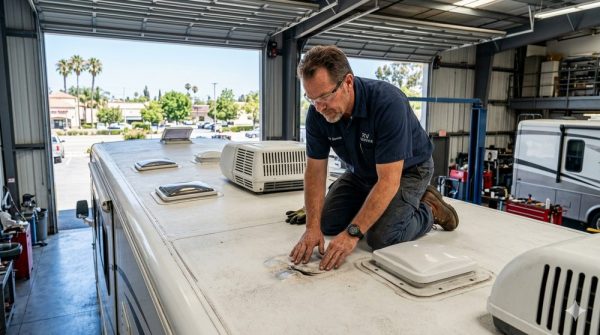
 If the ceiling of your RV has started to bubble, or your sidewall looks wavy in patches, you are likely looking at delamination. San Diego RV Center, located off Interstate 8 in El Cajon, has been diagnosing and repairing RV roof delamination since 1990 — and it is one of the most misunderstood structural problems in the industry. Caught early, it is a manageable fix. Left alone, it can turn a $600 repair into a $6,000 reconstruction job.
This guide covers what causes delamination, how to recognize it, and what a proper motorhome roof repair actually involves.
What Is RV Roof Delamination?
RV roofs and sidewalls are built in layers. There is an outer skin — usually fiberglass, aluminum, or rubber — bonded to a core material (typically wood or foam composite), with an interior wall or ceiling surface on the inside. These layers are glued together during manufacturing with industrial adhesive.
Delamination happens when those layers separate. The bond breaks down, and the outer skin begins to lift away from the core. What you see is bubbling, warping, soft spots, or visible surface separation. It does not always look like water damage at first. But water is almost always the reason.
What Causes RV Roof Delamination?
Water intrusion is the root cause in the vast majority of cases. When seals around roof vents, skylights, air conditioning units, or slide-out seams fail — even slightly — moisture finds its way into the core material. Over time, that moisture weakens the adhesive bond and degrades the substrate. Once the wood core gets wet, the separation accelerates.
Three other causes show up regularly at our shop:
- Age-related seal failure: Caulk and butyl tape around roof penetrations dry out over time, especially under San Diego’s UV exposure. A hairline crack in aging sealant admits more water than most owners expect.
- Thermal cycling: The constant expansion and contraction from hot days and cool nights stresses the adhesive bond repeatedly over years of use.
- Impact damage: A low-clearance collision or a falling tree limb can compromise the outer skin without visible cracking, leaving an entry point for water while the surface still looks intact.
 How to Recognize Delamination Before It Spreads
 How to Recognize Delamination Before It Spreads
On a sidewall, the first sign is usually a slightly wavy or rippled texture in the fiberglass — sometimes described as an “orange peel” surface that was not there before. Press gently and the material may flex in a way it should not.
On the roof, soft spots underfoot are the clearest signal. Walk the roof and pay attention to any give or flex away from the support ribs. A healthy RV roof should feel solid. Interior ceiling stains tend to show up later — by the time you see a stain, the damage has usually spread well beyond what the stain reveals. Do not wait for that signal before getting an inspection.
Why Delaying the Repair Costs You More
Delamination follows a predictable cost curve: slow at first, then steep. A localized area around a failed vent seal might cost $500–$900 to address properly. Let that same area sit through a wet season, and you may be looking at full substrate replacement, interior ceiling board work, and possible slide-out frame repairs — totaling $3,000 to $8,000 or more.
The reason is straightforward. Once the wood core gets saturated, it does not dry out — it compresses and rots, which creates new voids, which admit more water. There is no natural stopping point. The progression is gradual for a while, then it is not.
Repair or Replace? What the Damage Actually Tells Us
Not every delamination case requires full panel replacement. When the outer skin is intact and the affected area is limited in size, a skilled technician can re-bond the layers using injection adhesive and clamping pressure. The panel returns to structural integrity without replacement.
Full replacement becomes necessary when the core material has degraded to the point where re-bonding will not hold — typically when the substrate is rotted, crumbling, or fully saturated. At that stage, the panel is removed, the damaged substrate is rebuilt, and a new outer skin is bonded and refinished. The only reliable way to know which situation you are in is a professional inspection with moisture metering. See the full range of RV repair services at San Diego RV Center.
Schedule a delamination inspection at San Diego RV Center — we will give you a straight answer on what the repair involves before any work begins.
How San Diego RV Center Handles Delamination
Every delamination repair at our shop starts with moisture mapping. We do not assume the visible damage defines the boundary — water typically travels farther than the surface shows. A calibrated moisture meter tells us where the wet zone actually ends.
From there, we determine the right approach: injection re-bonding when the substrate is structurally sound, or partial to full panel replacement when the core has degraded. You get a written estimate with a realistic timeline before any work starts, and every repair carries a warranty on both labor and materials.
For roof work especially, we offer Rhino roof coating as a protective finish after repairs. It forms a solid, waterproof barrier over the entire roof surface — far more durable than standard sealants, and one of the most effective ways to prevent future moisture intrusion from the top down. Learn how we serve RV owners across San Diego County.
Frequently Asked Questions About RV Roof Delamination
How much does RV roof delamination repair cost?
Cost depends on how far the damage has spread and the condition of the core material. Small re-bonding repairs can start around $400–$600. Full panel replacement with substrate rebuilding typically runs $1,500–$5,000 depending on roof material, panel size, and how much interior work is involved. An inspection with moisture metering is the only way to give you an accurate number.
Can delamination be fixed without replacing the entire panel?
Yes — if the core material is still structurally sound and the outer skin is intact, injection adhesive re-bonding is a legitimate repair that holds well. The catch is that you cannot determine this from a visual inspection alone. Moisture metering the substrate is the only reliable test. If the wood is rotted or saturated, re-bonding will not hold long-term and replacement is the right call.
Is RV roof delamination covered by insurance?
In most cases, no. Insurers generally treat delamination as a maintenance issue rather than a covered loss. If the damage originated from a specific covered event — a collision, a falling object, or a severe storm — there may be a path to a claim. San Diego RV Center can document the damage and its probable origin to support your case if that situation applies.
How long does delamination repair take at a shop?
Simple re-bonding repairs are often completed in one to two business days. Full panel replacement with substrate rebuilding and exterior refinishing typically runs four to seven business days. We give you a specific timeline with every written estimate so you can plan around your rig being in the shop.
The Maintenance That Prevents Delamination
The most effective thing any RV owner can do is inspect and reseal every roof penetration point once a year. Vents, AC units, antennas, skylights, and slide-out seams all use sealant that dries, cracks, and pulls away over time — especially under San Diego’s UV load. Look for dullness, cracking, or any sign of the sealant lifting from the surrounding surface.
A full roof resealing service runs roughly $150–$300. That same neglected seal, given one or two wet seasons, can produce delamination damage that costs ten times that to repair properly. According to the Recreation Vehicle Industry Association (RVIA), water intrusion from failed seals is the leading cause of structural damage in RVs more than five years old — and it is almost entirely preventable with routine maintenance.
Annual inspections are not optional maintenance for a rig you rely on. They are the difference between a $200 sealant job and a structural rebuild.
Concerned About Your RV Roof?
If you have noticed soft spots, bubbling, or any surface separation on your RV’s roof or sidewalls, do not wait. Early diagnosis is the difference between a simple re-bond and a costly panel replacement.
Schedule Your Inspection or call us at (619) 561-3531.